
CONTROLLING ENDOTOXIN CONTAMINATION ON STERILE CLEANROOM GLOVES
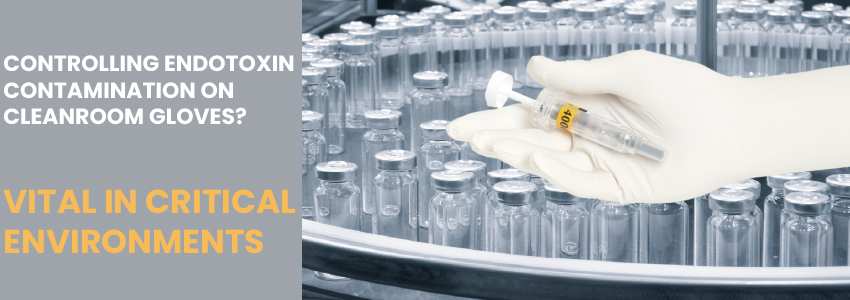
Injectable pharmaceuticals or implantable medical devices contaminated with endotoxins can cause a very serious patient reaction.
Endotoxin contamination of batches of injectable solutions or implants can also have significant financial consequences for the manufacturer.
Therefore, monitoring for endotoxin contamination on sterile cleanroom nitrile gloves and latex gloves is a key concern for critical environments, including the implantable medical devices industry and the pharmaceutical industry.
What are bacterial endotoxins and their impact?
What are bacterial endotoxins?
Endotoxins, also known as lipopolysaccharides (LPS), are components of the outer membrane of Gram-negative bacteria. Examples of Gram-negative bacteria include E. coli, Salmonella, Legionella and Neisseria.
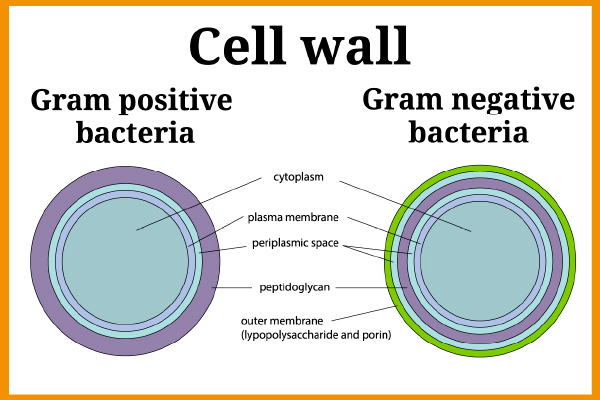
Figure 1 – Cell wall of Gram positive and Gram negative Bacteria
Gram-negative bacteria are widely present in the environment, including in water systems and the digestive tract. Endotoxins can be released when these bacteria break down or lyse and may remain present even when the bacteria themselves are no longer viable.
What are the consequences of endotoxin contamination?
Bacterial endotoxins can activate the human and animal immune system and trigger an inflammatory response. Depending on the level of exposure, this response can range from fever to more severe systemic reactions.
Fever is one of the characteristic responses to endotoxin exposure. This is why bacterial endotoxins are classified as pyrogens, substances that can cause a rise in body temperature.
When endotoxins enter the bloodstream, high levels of exposure may trigger severe systemic inflammatory responses. This is why endotoxin control is particularly important for injectable pharmaceuticals and other products intended to come into contact with the bloodstream.
In critical environments such as the case in the pharmaceutical industry, endotoxin monitoring is essential. This is particularly important in the production of pharmaceutical-grade water, parenteral and injectable medicinal products, including infusion and dialysis fluids, and implantable medical devices.
Reducing endotoxin levels on cleanroom gloves
Endotoxins are known to be the most common source of pyrogens in pharmaceuticals and medical devices.
Endotoxins are membrane residues of Gram-negative bacteria, which are widely present in the environment. In addition, endotoxins are highly resistant to disinfection or sterilisation processes including gamma-irradiation.
This is why the bioburden of nitrile and latex gloves should be limited as much as possible before sterilisation.
Bioburden is the population of viable microorganisms present on or in a product. Potential sources of bioburden during glove manufacturing include:
- Raw materials and process water used during manufacturing.
- Operators involved in the manufacturing process.
- Glove cleaning and packaging operations.
The bioburden of SHIELD Scientific sterile gloves is tested by an independent external laboratory in accordance with ISO 11737-1 as part of the SHIELD Scientific quality control process.
For critical applications, both sterility and endotoxin control may therefore need to be considered when selecting materials and protective equipment that could contribute to product contamination.
Sterility: For radiation-sterilised gloves, the sterilisation process must be validated to achieve the specified Sterility Assurance Level (SAL). ISO 11137-2 defines methods for establishing the sterilisation dose required to achieve an SAL of 10⁻⁶.
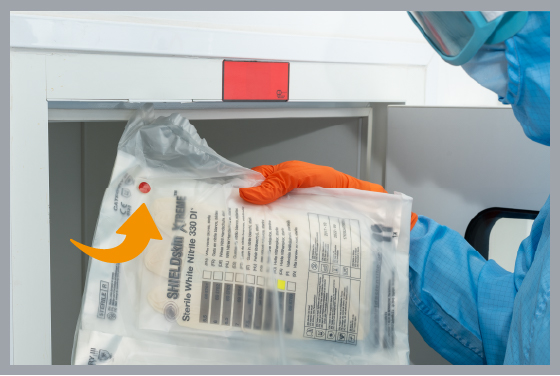
Figure 2 – SHIELDskin XTREME™ sterile gloves PE bag with sterilisation indicator
Endotoxin control: Sterilisation and endotoxin control are not the same thing. Sterilisation is intended to control viable microorganisms, whereas bacterial endotoxins can remain even after microorganisms are no longer viable. Therefore, controlling the bioburden and endotoxin levels throughout the glove manufacturing process is important, including through appropriate washing and cleanliness controls before sterilisation.
Why is it important to control the endotoxin levels on sterile cleanroom gloves?
Sterility and low endotoxin levels are two distinct aspects of contamination control. A sterile glove has undergone a validated sterilisation process to control viable microorganisms, but this does not necessarily guarantee a low endotoxin level.
For pharmaceutical manufacturers and manufacturers of implantable medical devices, endotoxin contamination should therefore be considered throughout the production process, from raw materials to finished products, including protective equipment worn by cleanroom operators.
Indeed, the gloved hand can be in direct contact with injectable solutions or their containers and implantable medical devices. Gloves are therefore potentially a source of contamination.
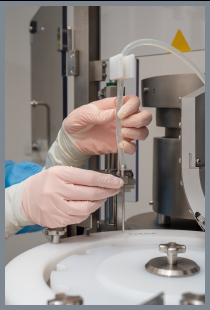
Figure 3 – Operator changing a filling machine needle while wearing two pairs (double-gloving) of SHIELD Scientific sterile gloves
Standard nitrile and latex single-use gloves undergo minimal treatment once they have completed the dipping and drying steps. Their cleanliness level may therefore not be suitable for cleanroom applications. Contamination with Gram-negative bacteria before sterilisation may contribute to residual endotoxin contamination. Even for sterile cleanroom gloves, sterility alone does not provide information about the endotoxin level.
In addition, particles can act as potential carriers of endotoxins. Selecting cleanroom gloves with low and controlled particle levels can therefore help reduce the risk of transferring particle-associated endotoxins and support the overall contamination control strategy.
Therefore, selecting sterile cleanroom gloves with a low endotoxin claim (≤20 EU per pair, as defined in EN 455-3:2023) can support endotoxin contamination control. Batch testing provides additional batch-specific information on endotoxin levels.
How is the endotoxin level of sterile cleanroom gloves monitored?
Regulatory framework for endotoxin contamination of sterile gloves
Annex 1 of the European Union’s GMP is one of the main documents governing the manufacture and control of medicinal products. This document provides guidance for the manufacture of sterile medicinal products based on Quality Risk Management (QRM) principles, with the objective of preventing microbial, particulate and endotoxin/pyrogen contamination of the final product. It also requires manufacturers to implement a Contamination Control Strategy (CCS) to identify critical control points and assess the effectiveness of contamination control measures. As part of this risk-based approach, sterile cleanroom gloves should therefore be considered where they may represent a potential source of contamination.
EN 455-3:2023 (Medical gloves for single use – Part 3: Requirements and testing for biological evaluation) specifies requirements for the evaluation of bacterial endotoxins. Endotoxin levels are expressed in Endotoxin Units (EU) per pair of gloves. For sterile gloves labelled as “low endotoxin”, the endotoxin content must not exceed 20 EU per pair. Testing is performed in accordance with the bacterial endotoxin test methods of the European Pharmacopoeia, Monograph 2.6.14.
Methods for detecting bacterial endotoxins
Bacterial endotoxins testing (BET) have traditionally relied on Limulus Amebocyte Lysate (LAL), a reagent derived from horseshoe crab amoebocytes. LAL reacts in the presence of bacterial endotoxins and provides the basis for several qualitative and quantitative test methods.

Figure 4 – Horseshoe crab-Limulus polyphemus
Recombinant Factor C (rFC) provides an animal-free alternative for bacterial endotoxin testing. The revised Ph. Eur. 2.6.14 introduces rFC as Method G, which will become applicable on 1 January 2027.
Test methods for determining endotoxin levels on sterile gloves
To determine the endotoxin level of sterile gloves, the outer surface of each pair is extracted using endotoxin-free water for 40 to 60 minutes at a temperature between 37 °C and 40 °C. The extract may then be centrifuged to remove particles before being tested for bacterial endotoxins.
Traditional LAL-based bacterial endotoxin testing includes three main techniques:
- Gel-clot test: a qualitative or semi-quantitative method in which the presence of endotoxins results in gel formation.
- Kinetic turbidimetric test: a quantitative method that measures changes in turbidity over time following the reaction between endotoxins and the LAL reagent.
- Chromogenic test: a quantitative method that measures a colour reaction generated in response to endotoxins.
The test result is expressed in Endotoxin Units (EU) per pair of gloves. Under EN 455-3:2023, sterile gloves labelled as “low endotoxin” must not exceed 20 EU per pair.
SHIELD Scientific low endotoxin content sterile gloves for critical environments
For pharmaceutical manufacturing, implantable medical device production and other critical environments, selecting sterile cleanroom gloves with specified low endotoxin levels can help reduce the risk of endotoxin contamination.
Glove selection should therefore be considered as part of the overall Contamination Control Strategy (CCS) and Quality Risk Management (QRM) approach, alongside other measures used to control microbial, particulate and endotoxin/pyrogen contamination.
SHIELD Scientific has developed a range of nitrile and latex cleanroom gloves with different cleanliness levels achieved through deionised water washing processes. The DI classification helps identify these different levels of glove cleanliness:
DI – Basic contamination control: Cleanroom gloves with a single deionised water wash, with a particle level specification of <3,000 particles/cm² ≥0.5 µm.
DI+ – High contamination control: Cleanroom gloves with three deionised water washes, with a particle level specification of <1,200 particles/cm² ≥0.5 µm.
DI++ – Extreme contamination control: Cleanroom gloves with multiple deionised water washes, with a particle level specification of <850 particles/cm² ≥0.5 µm.
SHIELDskin XTREME™ sterile cleanroom gloves are designed to support contamination control in critical environments, including pharmaceutical manufacturing environments operating under GMP requirements. SHIELD Scientific sterile nitrile and latex cleanroom gloves are batch tested for endotoxins, with a specified endotoxin level of <20 EU per pair. They are sterilised by gamma irradiation to a Sterility Assurance Level (SAL) of 10⁻⁶.
A Certificate of Irradiation (CoI) is provided with each batch of SHIELD Scientific sterile nitrile and latex cleanroom gloves. A Certificate of Conformance (CoC) provides batch-specific data on particle and endotoxin levels, supporting the documentation of glove cleanliness and contamination control.
Looking for sterile cleanroom gloves with controlled particle and endotoxin levels?
REQUEST SAMPLES or CONTACT A SHIELD Scientific REPRESENTATIVE to discuss the most suitable gloves for your contamination control requirements.
Share this interesting information

No. A sterile cleanroom glove does not necessarily have a low endotoxin level. Sterilisation is intended to control viable microorganisms, but bacterial endotoxins may remain even when microorganisms are no longer viable. Sterility and endotoxin levels are therefore two distinct aspects of contamination control. When low endotoxin levels are required, they should be supported by a specified endotoxin limit and appropriate testing. Under EN 455-3:2023, sterile gloves labelled as “low endotoxin” must not exceed 20 EU per pair.
For sterile gloves, “low endotoxin” refers to a controlled and tested level of bacterial endotoxins. Endotoxin levels can be determined using the test method described in EN 455-3:2023 and are expressed in Endotoxin Units (EU) per pair of gloves. EN 455-3:2023 sets a limit of 20 EU per pair for the “low endotoxin” claim within the scope of the standard. A low endotoxin level is distinct from sterility and should therefore be specifically tested when endotoxin contamination needs to be controlled.
Measuring bacterial endotoxins on sterile cleanroom gloves involves two key stages: recovering potential endotoxin contamination from the glove surface and measuring it using a suitable bacterial endotoxin test. Endotoxin-free water is used to collect endotoxins that may be present on the glove so that the resulting sample can be analysed. Detection can be performed using established Limulus Amebocyte Lysate (LAL) assays or recombinant Factor C (rFC) technology. The result provides a quantitative measure of the endotoxin level and is reported in Endotoxin Units per pair of gloves (EU/pair), allowing different glove specifications to be assessed on a consistent basis.
Particle cleanliness and endotoxin levels describe different aspects of a sterile cleanroom glove’s contamination profile and should be assessed separately. These parameters should not be treated as interchangeable: particle levels characterise particulate cleanliness, while endotoxin testing addresses bacterial endotoxin contamination. Importantly, a low particle level cannot be used to predict a low endotoxin level. Evaluating both specifications therefore provides a more complete contamination profile when selecting sterile cleanroom gloves for critical applications.
For endotoxin-sensitive applications, the starting point should be a clearly specified and tested endotoxin level for the sterile cleanroom glove. This specification should be considered in relation to the contamination risks and cleanliness requirements of the actual process, rather than relying on sterility or cleanroom classification alone. Supporting documentation should provide test data for the relevant cleanliness characteristics, allowing users to verify the glove’s endotoxin specification and assess its suitability for the intended cleanroom application.
ANY QUESTIONS?
FAQ
Looking for answers about cleanroom gloves or laboratory gloves? This FAQ section covers key topics such as disposable glove usage, contamination control, hand protection and glove selection. Explore practical guidance or contact SHIELD Scientific to identify the most suitable solution for your cleanroom or laboratory application.
Contact us